

Essential Skills Required to Become a Successful Data Scientist
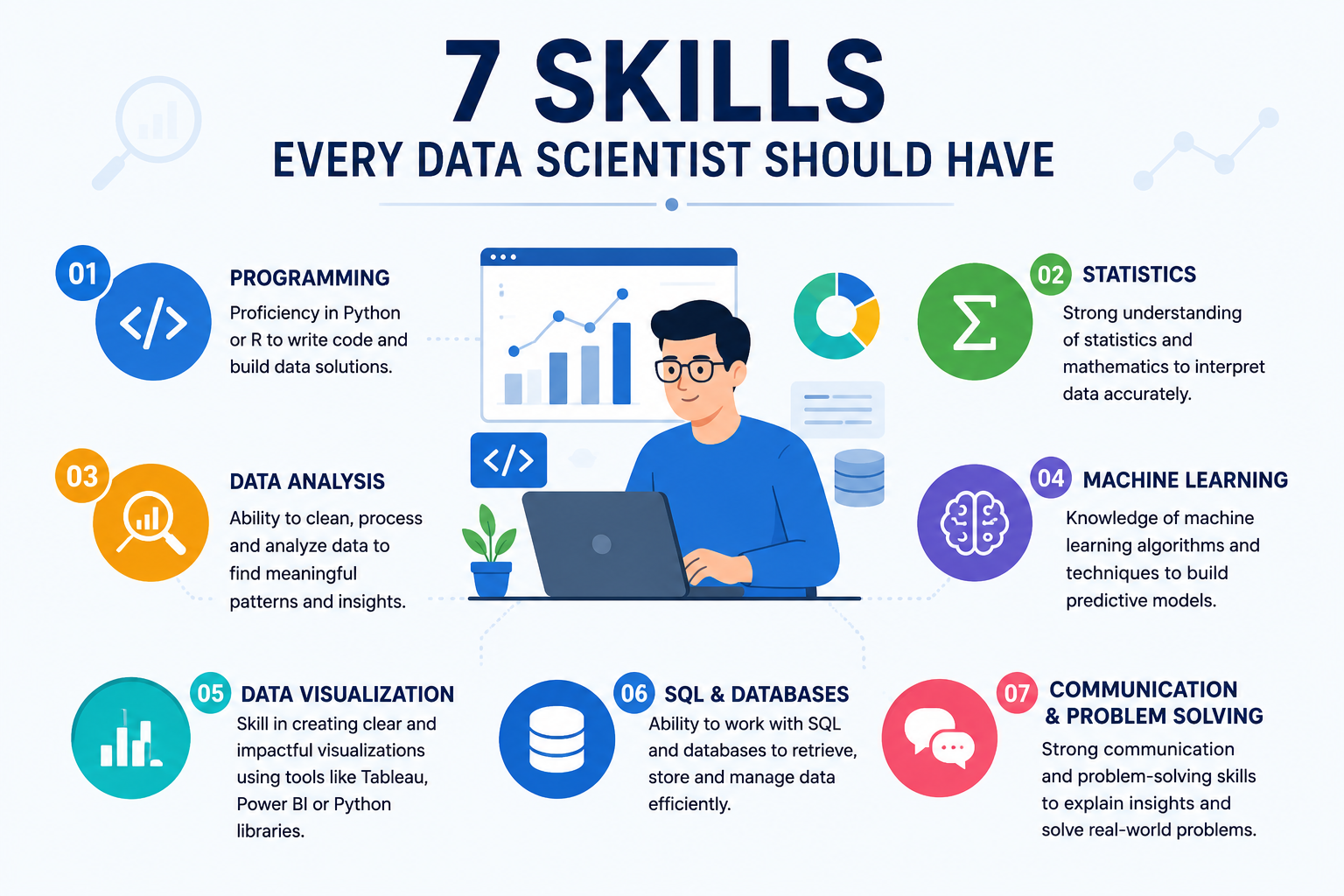
7 Skills Every Data Scientist Should Have
Data science has become one of the fastest-growing fields in the technology industry. Businesses collect large amounts of data every day, and they rely on data scientists to turn that information into useful insights. From healthcare and finance to retail and education, organizations use data to make smarter decisions and improve their services.
Becoming a successful data scientist requires more than just technical knowledge. It also involves problem-solving, communication, and the ability to understand business needs. Here are seven important skills every data scientist should develop.
1. Programming Skills
Programming is one of the core skills in data science. Languages such as Python and R are commonly used to analyze data, automate tasks, and build machine learning models.
A good understanding of programming allows data scientists to process large datasets efficiently and create reliable solutions for real-world problems.
2. Statistics and Mathematics
Statistics helps data scientists understand patterns, relationships, and trends within data. Concepts such as probability, averages, distributions, and hypothesis testing are commonly used when analyzing information.
Mathematics also plays an important role in developing machine learning models and making accurate predictions.
3. Data Analysis
Collecting data is only the first step. Data scientists must know how to clean, organize, and analyze information before drawing meaningful conclusions.
Strong analytical skills help identify trends, solve business problems, and support better decision-making.
4. Machine Learning Knowledge
Machine learning enables computers to learn from data without being programmed for every task. Data scientists use machine learning techniques to build recommendation systems, detect fraud, predict customer behavior, and automate decision-making.
Understanding the basics of machine learning helps professionals work with modern AI-powered applications.
5. Data Visualization
Data becomes easier to understand when it is presented visually. Charts, graphs, dashboards, and reports help explain complex information in a simple way.
Data visualization allows business teams and decision-makers to quickly understand insights without reading large amounts of raw data.
6. SQL and Database Management
Most organizations store their information in databases. Data scientists need to know how to retrieve, filter, and organize data using SQL.
Understanding databases makes it easier to work with structured information and prepare data for analysis.
7. Communication and Problem-Solving
Technical skills are important, but they are not enough on their own. Data scientists must communicate their findings clearly to managers, clients, and team members.
Good communication helps explain complex results in simple language, while strong problem-solving skills allow professionals to choose the best solution based on available data.
Why These Skills Matter
Modern businesses depend on accurate data to improve products, understand customers, reduce costs, and plan future strategies. Data scientists combine technical knowledge with business understanding to transform raw information into valuable insights.
As technology continues to evolve, professionals who develop these seven skills will be better prepared to work on real-world challenges across many industries.
Conclusion
Successful data scientists combine programming, statistics, data analysis, machine learning, visualization, database management, and communication skills. These abilities work together to help organizations make informed decisions and solve complex problems. Whether you are just beginning your learning journey or looking to strengthen your existing knowledge, developing these essential skills can provide a strong foundation for a future in data science.
 Romaian
 English
 Arabic
 French
 Spanish
 Portuguese
 Deutsch
 Turkish
 Dutch
Dutch
 Italiano
 Russian
 Portuguese (Brazil)
 Greek
Greek