

How AI Improves Policy Underwriting Without Increasing Risk
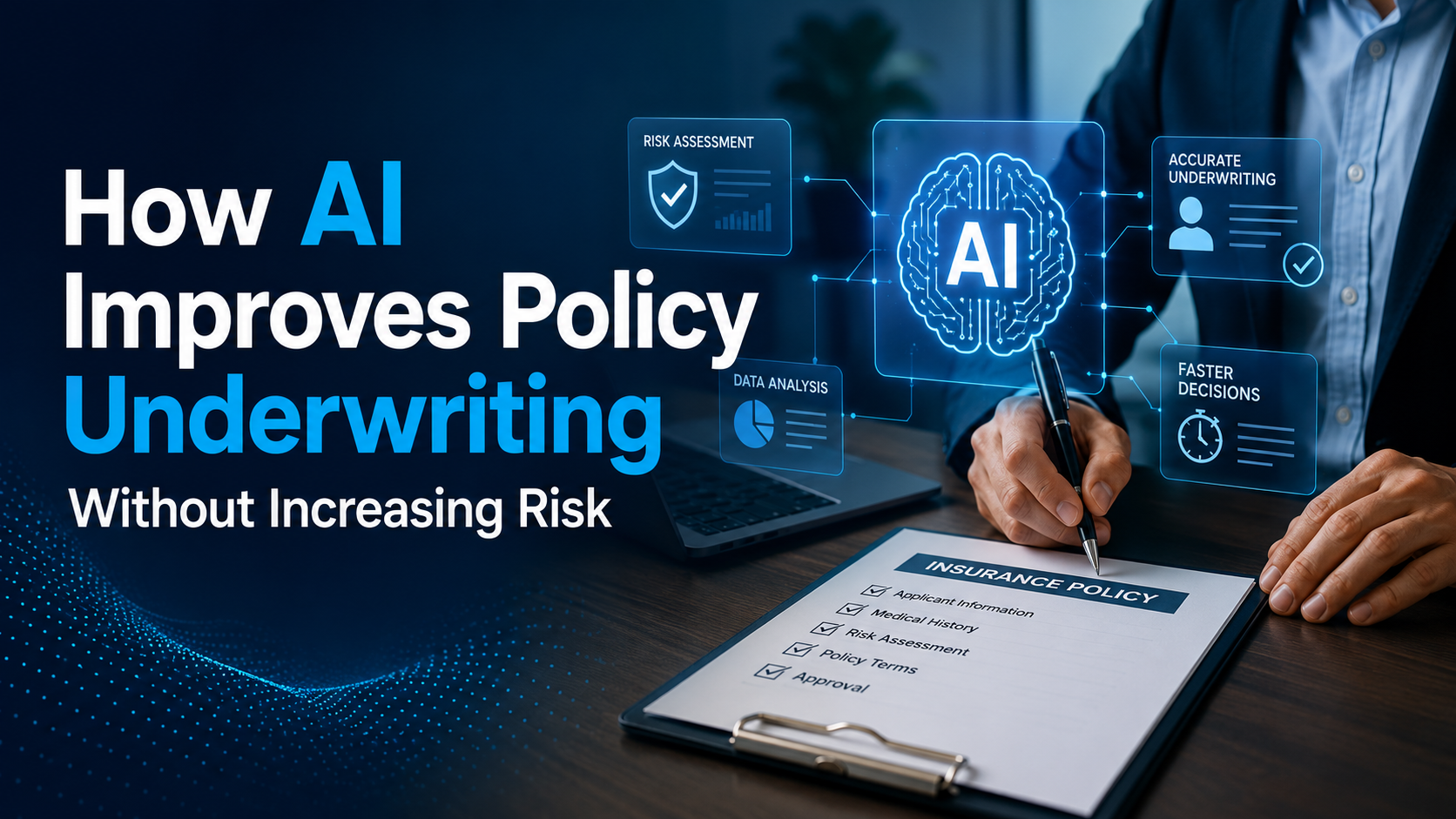
Policy underwriting requires insurers to make accurate decisions based on incomplete, complex, and sometimes inconsistent information. Underwriters must evaluate applicant risk, determine suitable coverage, set fair pricing, and comply with regulatory requirements without delaying the customer experience.
Artificial intelligence can improve this process by helping underwriting teams analyze information faster, identify meaningful risk indicators, and apply approved rules more consistently. However, using AI does not mean removing professional judgment from underwriting. The safest and most effective approach is to use AI as a decision-support system that strengthens human evaluation.
When properly governed, AI can improve underwriting efficiency without increasing exposure to inaccurate pricing, unfair decisions, fraud, or regulatory risk.
Why Traditional Underwriting Processes Create Operational Challenges
Traditional underwriting often involves reviewing application forms, medical records, claims histories, inspection reports, financial documents, and third-party information. Much of this data may exist in separate platforms or arrive in unstructured formats such as PDFs, scanned documents, emails, and handwritten forms.
Underwriters may spend a significant amount of time collecting information before they can begin evaluating the actual risk. This creates several challenges:
- Applications remain in review queues for longer periods.
- Important information may be overlooked during manual assessment.
- Similar cases may receive different treatment.
- Low-risk applications require unnecessary human effort.
- Complex applications may not be escalated early enough.
AI helps reduce these operational limitations by organizing information, highlighting inconsistencies, and directing cases to the appropriate review process.
How AI Improves Data Collection and Verification
AI can collect information from application forms, policy administration systems, claims databases, medical documents, and approved third-party sources. Technologies such as optical character recognition and natural language processing can extract relevant data from documents that would otherwise require manual review.
The extracted information can be validated against application responses and existing records. The system may identify missing fields, conflicting dates, inconsistent medical disclosures, or unsupported statements.
For example, an applicant may mention a health condition in a medical document but leave it out of the application form. AI can flag the inconsistency for an underwriter instead of making an automatic decision.
This improves the quality of the information used during underwriting. It also reduces the chance that a policy is issued based on incomplete or inaccurate evidence.
Applying Underwriting Rules More Consistently
Insurance underwriting depends on established rules, risk thresholds, and internal guidelines. Human expertise is necessary, but manual interpretation can sometimes lead to inconsistent outcomes.
AI systems can apply approved underwriting criteria uniformly across applications. They can review applicant characteristics, compare them with relevant risk guidelines, and recommend an appropriate category or next action.
Consistency does not mean that every applicant receives the same treatment. It means that similar cases are assessed using the same evidence standards and escalation rules.
An underwriter can still review the recommendation, consider unusual circumstances, and override the result when the available evidence supports a different decision.
Accelerating Low-Risk Applications
Many applications are complete, straightforward, and aligned with standard underwriting guidelines. Requiring experienced underwriters to review every detail of these cases can create unnecessary delays.
AI can identify low-complexity applications and route them through an accelerated review process. Applications with conflicting information, unusual medical histories, high coverage values, or uncertain risk indicators can be escalated to specialist teams.
This approach allows insurers to use underwriting expertise where it provides the greatest value. Routine cases move faster, while complex cases receive more focused attention.
Faster processing does not require weaker controls. It depends on clearly defined eligibility rules, confidence thresholds, and human review requirements.
Using Predictive Analysis to Strengthen Risk Assessment
AI models can analyze historical underwriting, policy, and claims data to identify patterns associated with future outcomes. These patterns may help insurers understand which combinations of factors are linked to higher claims frequency, policy cancellation, fraud, or adverse loss experience.
Predictive analysis can support more informed decisions, but it should not be treated as unquestionable evidence. A statistical relationship does not always explain why a risk exists.
Insurers should use predictive indicators to support investigation and decision-making rather than automatically approve or reject applicants.
For example, a model may identify that a certain combination of medical history, age, and treatment frequency requires additional review. The underwriter can then request further evidence before deciding whether to accept the application, adjust pricing, or apply exclusions.
Integrating AI Into Health Insurance Underwriting Workflows
Health insurance underwriting often requires the evaluation of medical histories, treatment records, prescription information, coverage details, and eligibility requirements. These workflows can become difficult to manage when data is spread across disconnected systems.
Organizations investing in health insurance software development services can integrate AI into their existing underwriting platforms to automate document extraction, verify medical details, flag incomplete applications, and improve case prioritization.
The purpose of this integration should not be to automate every underwriting decision. It should provide underwriters with more reliable information and reduce time spent on repetitive administrative work.
AI-supported workflows can also help insurers standardize how medical evidence is collected and reviewed. This reduces delays caused by missing documents and improves visibility into the current status of each application.
Detecting Fraud and Application Misrepresentation
Underwriting losses may occur when applicants provide inaccurate information, omit important facts, manipulate documents, or use false identities.
AI can compare application data with trusted internal and external sources to identify suspicious patterns. It may detect repeated addresses, inconsistent identities, altered documents, unusual submission behaviour, or links between applications that appear unrelated.
These indicators should trigger additional verification rather than immediate rejection. Fraud signals can sometimes be caused by legitimate circumstances, such as shared addresses or administrative errors.
Human investigation remains necessary to determine whether the application contains intentional misrepresentation or a correctable mistake.
By identifying suspicious cases earlier, insurers can prevent inaccurate information from entering the insured portfolio.
Maintaining Human Oversight in AI-Assisted Decisions
AI should not operate as an unaccountable decision-maker in policy underwriting. Human oversight is essential when an application involves unusual circumstances, uncertain data, conflicting evidence, or a decision that may significantly affect the applicant.
Underwriters should be able to:
- Review the information used by the model
- Understand the factors behind a recommendation
- Request additional evidence
- Challenge an automated result
- Override the recommendation when justified
- Document the reason for the final decision
Human review is particularly important for applications involving complex medical conditions, non-standard occupations, unusual financial circumstances, or high-value coverage.
The objective is to combine machine-supported analysis with professional judgment, not to replace one with the other.
Preventing Bias and Unfair Outcomes
AI systems can produce unfair outcomes when they are trained on incomplete, unrepresentative, or historically biased data. They may also rely on variables that indirectly reflect protected characteristics.
Insurers should test underwriting models before deployment and monitor them throughout their operational life. Testing should examine approval rates, pricing recommendations, referral patterns, error rates, and outcomes across relevant applicant groups.
Each variable used by the model should have a clear business purpose. Insurers should also investigate whether certain data points act as indirect substitutes for sensitive personal characteristics.
When a model produces unexplained differences between comparable groups, the insurer should identify the cause and correct the issue before continuing to use the system.
Fairness testing is not a one-time compliance exercise. It is an ongoing part of responsible model management.
Creating Explainable and Auditable Underwriting Systems
Underwriting decisions must be understandable to internal teams, regulators, auditors, and affected applicants.
An AI-supported underwriting system should record the data used, the model version applied, the recommendation generated, any warnings identified, and the final action taken by the underwriter.
A strong audit trail should include:
- Sources of applicant information
- Risk indicators identified by the system
- Rules applied during assessment
- Missing or conflicting information
- Human overrides and their justification
- Final underwriting decisions
This documentation allows insurers to review complaints, investigate errors, evaluate model performance, and demonstrate that appropriate controls were followed.
Explainability also helps underwriting teams determine whether the model is identifying commercially relevant risks or relying on unreliable patterns.
Protecting Sensitive Applicant Information
AI-supported underwriting may involve medical information, financial records, identity data, lifestyle details, and other sensitive information. Expanding data access without proper safeguards can create privacy and cybersecurity risks.
Insurers should collect only the information required for legitimate underwriting purposes. Access should be restricted according to employee roles, and sensitive data should be encrypted during storage and transmission.
Third-party data providers should also be assessed for accuracy, consent practices, security controls, and regulatory compliance.
Data should not be used simply because it is available. Every data source should have a clear connection to the underwriting decision and should meet applicable legal and ethical requirements.
Monitoring AI Models After Deployment
An AI model may perform well during initial testing but become less reliable as customer behaviour, medical practices, product structures, or economic conditions change.
Insurers should continuously monitor model performance for unusual approval patterns, increasing error rates, data drift, false positives, and changes in claims experience.
Monitoring should examine whether:
- Underwriters frequently override certain recommendations
- Referral rates increase unexpectedly
- Particular applicant groups experience higher error rates
- Claims outcomes differ from expected risk levels
- Model confidence decreases over time
When performance falls outside approved limits, the model should be reviewed, retrained, restricted, or temporarily removed from the underwriting process.
Conclusion
AI improves policy underwriting by helping insurers verify information, apply risk rules consistently, identify potential fraud, prioritize complex applications, and support more informed decisions.
Its value depends on responsible implementation. Human oversight, explainable recommendations, bias testing, secure data handling, reliable audit trails, and continuous monitoring must remain central to the underwriting process.
When insurers combine technology with disciplined governance and professional judgment, they can process applications faster without compromising fairness, accuracy, compliance, or long-term risk control.
 Italiano
 English
 Arabic
 French
 Spanish
 Portuguese
 Deutsch
 Turkish
 Dutch
Dutch
 Russian
 Romaian
 Portuguese (Brazil)
 Greek
Greek