

RBI Information Security Audit: A Practical Guide for Financial Businesses
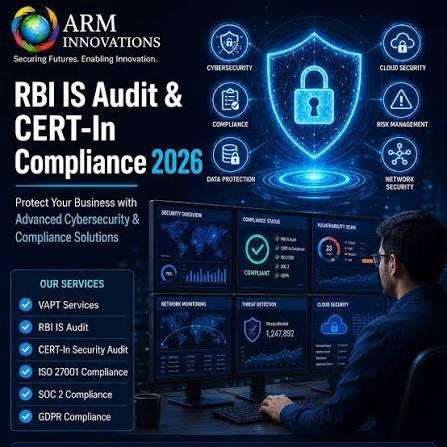
For banks, NBFCs, fintech companies, payment aggregators, and other RBI-regulated entities, security is no longer just an IT responsibility. It is a board-level business requirement. Customer data, digital transactions, APIs, cloud infrastructure, mobile banking platforms, and third-party integrations all create risk. An RBI information security audit helps organizations understand whether their technology, policies, people, and processes are strong enough to meet regulatory expectations and withstand modern cyber threats.
The main purpose of this audit is to evaluate how well a financial organization protects confidentiality, integrity, and availability of critical systems. It checks whether access controls are properly implemented, whether sensitive data is protected, whether incident response is ready, and whether technology risks are being monitored continuously. For regulated entities, this type of assessment is important because RBI has issued cybersecurity and IT governance expectations for banks and other financial institutions.
A well-planned assessment does not begin with scanning tools. It begins with scope. The organization should identify all critical applications, data flows, infrastructure, vendors, cloud environments, payment systems, user roles, and business processes that support regulated operations. Once the scope is clear, the audit team can map applicable RBI expectations, internal policies, and industry security practices to the organization’s real environment.
One major part of an RBI information security audit is governance review. Auditors examine whether the board and senior management have visibility into cyber risk. They check information security policies, risk registers, exception approvals, vendor governance, asset classification, and accountability for security decisions. Without governance, even the best technical controls can fail because nobody owns the risk.
The technical assessment is equally important. During an RBI information security audit, auditors review network security, server hardening, endpoint protection, identity and access management, password policies, multi-factor authentication, encryption, backup controls, logging, monitoring, and vulnerability management. For fintech and digital platforms, API security, secure coding, cloud configuration, and application penetration testing become especially important.
Another key area is incident response. Financial organizations must be prepared to detect, report, contain, investigate, and recover from cyber incidents. An RBI information security audit reviews whether the incident response plan is documented, tested, and understood by the right teams. It also checks whether logs are retained, alerts are reviewed, and escalation paths are defined. In real attacks, delay often causes more damage than the initial breach.
Third-party risk is also a major concern. Many financial businesses depend on SaaS platforms, payment processors, cloud service providers, call centers, development vendors, and support partners. An RBI information security audit should verify whether vendors are assessed before onboarding, monitored during the relationship, and reviewed at renewal. Contracts should include security responsibilities, data protection clauses, audit rights, breach reporting timelines, and exit procedures.
For organizations preparing for an RBI information security audit, evidence readiness matters. Policies alone are not enough. Auditors need proof such as access review records, vulnerability reports, patch logs, backup restoration results, training records, incident drill reports, vendor assessment documents, change approvals, and risk treatment plans. The stronger the evidence, the smoother the audit.
Common gaps found during an RBI information security audit include weak asset inventory, incomplete vendor documentation, missing access reviews, poor log monitoring, unpatched systems, outdated policies, lack of secure SDLC, and limited incident response testing. These gaps may look small individually, but together they increase regulatory and operational risk.
ARM Innovations helps financial organizations prepare for and complete an RBI information security audit with a structured, practical approach. Our cybersecurity team reviews governance, policies, applications, infrastructure, cloud systems, APIs, vendors, and technical controls. We also conduct VAPT, secure code review, cloud security assessment, vulnerability management, and remediation validation so organizations can move from audit findings to actual risk reduction.
The benefit of an RBI information security audit is not only compliance. It improves customer trust, reduces breach exposure, strengthens internal accountability, and gives leadership a clear view of cyber risk. In a financial ecosystem where digital fraud, ransomware, API abuse, and supply-chain attacks are increasing, a one-time checklist approach is not enough.
The best approach is to treat an RBI information security audit as a continuous security improvement cycle. Assess the current state, identify gaps, prioritize risk, fix critical issues, validate remediation, and keep monitoring controls. This makes compliance easier and improves cyber resilience over time.
For RBI-regulated businesses, security must be measurable, documented, and defensible. A professional audit helps prove that the organization is taking information security seriously and is prepared for regulatory expectations. ARM Innovations can support your team with audit readiness, technical testing, policy review, compliance mapping, and remediation guidance to help you build a secure and compliant financial technology environment. This also helps teams avoid rushed fixes during supervision, because responsibilities, records, and remediation timelines are already documented in a format that management, auditors, and technology owners can understand. It also supports better budgeting for security upgrades across departments.

 English
 Arabic
 French
 Spanish
 Portuguese
 Deutsch
 Turkish
 Dutch
Dutch
 Italiano
 Russian
 Romaian
 Greek
Greek