

Snow Day Calculator Ontario: School Closure Guide 2026
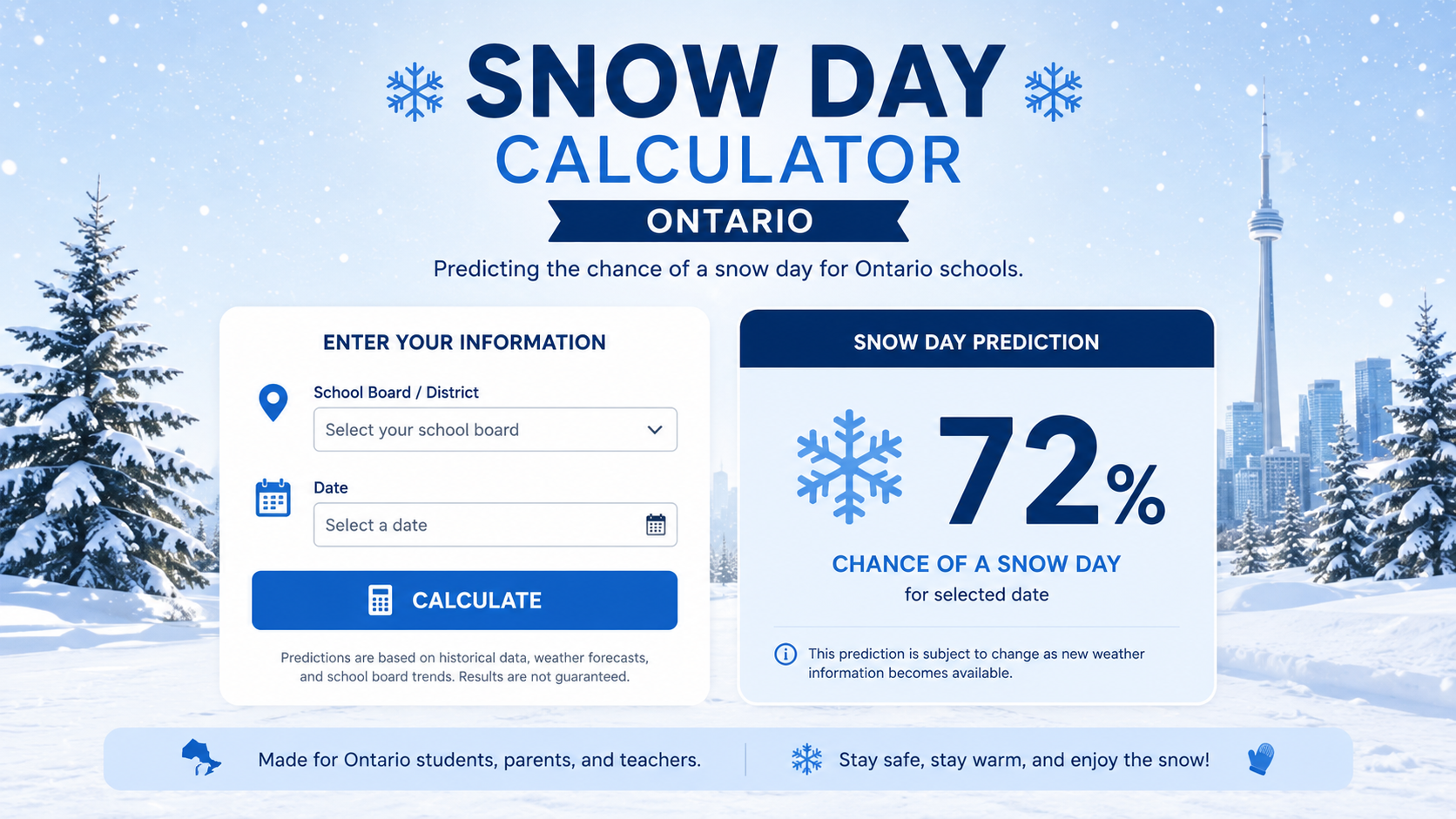
Introduction: Ontario Winters Are Not Like Other Places
You check Environment Canada at 9 PM. A winter storm warning is active. The kids are already negotiating their way out of tomorrow's homework. But between hope and reality sits one frustrating question: will school actually be cancelled?
Ontario parents and students face a unique challenge that most snow day tools are not built to handle. Ontario's school closure system is layered, board-specific, and often separates bus cancellations from full school closures entirely. A generic US-based calculator cannot account for the way TDSB, YRDSB, or OCDSB each make their own independent calls.
This 2026 guide breaks down exactly how a snow day calculator works for Ontario, which boards close under which conditions, what signals to watch for, and how to use these tools accurately so you are never caught scrambling at 5:30 AM.
What Makes Ontario Different From the US
Most snow day calculator articles online are written with American school districts in mind. Ontario operates under a fundamentally different model, and understanding that difference is what separates useful predictions from misleading ones.
The dual-track system is Ontario's defining feature. In most American districts, a school closure means everything stops. In Ontario, buses can be cancelled while schools stay fully open. This forces every family to make a separate judgment call: can my child travel safely on their own?
The Toronto District School Board illustrates this perfectly. With roughly 239,000 students across 582 schools, the TDSB notes that approximately 93 per cent of its students do not rely on school buses. So when TDSB cancels transportation, most students are still expected to attend. Schools close as a separate, more serious decision.
This is the single biggest gap in most snow day calculator Ontario tools. A reliable predictor must distinguish between bus cancellations and full school closures because they have completely different implications for families.
Ontario's Ontario-Specific Snow Day Definition (citable framework):
"In Ontario, a snow day has two distinct meanings: a bus cancellation day, where schools remain open but transportation stops, and a full closure day, where the school itself shuts down. A snow day calculator for Ontario is only useful if it models both outcomes separately."
How Ontario School Boards Actually Make the Decision
Understanding the decision process behind the prediction helps you read any calculator's output more accurately.
Each Ontario school board operates independently. There is no provincial directive that says "close all schools at X centimetres." The call rests with each superintendent or board director, made in the early morning hours based on real-time conditions.
Here is how the major boards approach it based on their public policies:
TDSB (Toronto District School Board) Canada's largest school board reviews forecasted and live weather conditions very early on storm mornings. The team assesses road conditions, bus route safety, and whether conditions will improve before the school day starts. Announcements are posted on tdsb.on.ca and broadcast on CP24 and 680 News by 6:00 AM.
PDSB (Peel District School Board) Covering Brampton, Mississauga, and Caledon, Peel announces closures and bus suspensions by 6:15 AM through its website, Twitter account, and local news. Student Transportation of Peel manages the bus side of the decision separately from school operations.
YRDSB (York Region District School Board) Bus cancellations are announced by 6:00 AM. When buses are cancelled, students are not marked absent if they stay home. York Region and York Catholic boards typically coordinate their decisions, though independent calls do happen on borderline storm days.
OCDSB (Ottawa-Carleton District School Board) The Ottawa Student Transportation Authority (OSTA) manages transportation decisions and posts cancellations by 6:15 AM. Ottawa's climate is harsher than the GTA, with more ice events and colder overnight temperatures, which affects the threshold at which closures occur.
HDSB (Halton District School Board) Halton announces decisions by 6:30 AM. The board's public data shows it closed schools one time during the entire 2024-2025 school year, demonstrating that full closures are rare even in moderate storm conditions.
Rural and Northern Boards Boards serving areas like Simcoe County (Barrie region), Algoma (Sault Ste. Marie), and Northern Ontario have lower thresholds than GTA boards. Rural bus routes often travel on county roads that take longer to treat, meaning closures or cancellations happen at lower snowfall totals than what would trigger the same response in Toronto.
How to Use a Snow Day Calculator for Ontario: Step-by-Step
Getting a reliable prediction from any snow day calculator ontario tool requires the right approach, not just the right tool.
Step 1: Enter your city or postal code correctly For Ontario, use the city name plus "ON" or "Canada" as a qualifier, or enter your full postal code in the standard Canadian format. Postal code entry typically produces more precise local results than city name alone, especially for GTA areas where multiple boards operate in overlapping zones.
Step 2: Select your school board if the option is available Better Ontario-focused tools let you specify TDSB, PDSB, YRDSB, OCDSB, HDSB, or other boards. This matters because boards in the same region can make different calls on the same storm day. Always select your specific board rather than relying on a general Toronto or Ottawa prediction.
Step 3: Check Environment Canada simultaneously The most effective approach combines the calculator's probability score with Environment Canada's active alerts. If your calculator shows above 70 per cent probability and Environment Canada has issued a winter storm warning or freezing rain advisory, treat that combination as a strong signal to prepare for closure or bus cancellation.
Step 4: Check the evening before and again at 5:30 AM Ontario boards make most announcements between 5:30 AM and 6:30 AM. Checking the calculator the evening before gives you a planning baseline. The 5:30 AM check reflects actual overnight conditions and is your most accurate read before official announcements come in.
Step 5: Always confirm through official board channels No calculator replaces the official announcement. After checking your probability percentage, verify directly on your board's website, official Twitter or social media, or through CP24 and local radio. For Ottawa families, Newstalk 580 CFRA carries OCDSB announcements as early as 5:30 AM.
The Ontario Closure Triggers Most Calculators Miss
Competitor tools tend to focus on snowfall totals. Ontario boards weigh several additional factors that a good snow day calculator for Ontario must account for.
Freezing rain outweighs snowfall in Ontario Ice storms are a more common closure trigger in Ontario than pure snowfall, particularly in the Ottawa Valley and areas east of Toronto. A thin glaze of freezing rain makes bus routes genuinely dangerous when 25 centimetres of dry snow would not. Always check the freezing rain probability alongside the snowfall forecast.
Wind chill is a standalone trigger When wind chill drops below -30 to -35 degrees Celsius, many boards cancel buses to protect students waiting at stops. This can trigger cancellations on clear, sunny days with no snow at all. Northern Ontario boards have lower wind chill thresholds than GTA boards because of the compounding effect of cold temperatures and rural road exposure.
Storm timing relative to the morning bus window Snow that arrives between 2:00 AM and 6:00 AM is the most dangerous scenario for Ontario boards. Road crews have less time to clear routes before the first pickups at 7:00 AM. The same storm arriving at noon would likely result only in an early dismissal announcement rather than a full morning cancellation.
Rural versus urban board geography Boards like SCDSB (Simcoe County, including Barrie) and boards across Eastern Ontario operate extensive rural bus networks on roads that are harder to treat quickly. These boards close or cancel transportation at lower thresholds than urban GTA boards where most students walk or use transit.
Ontario Snow Day Probability Guide: What the Numbers Mean
When your snow day calculator Ontario returns a percentage, here is how to interpret it in the Ontario context specifically:
| Probability | What It Means for Ontario Families |
|---|---|
| 0% to 20% | No action needed. Check Environment Canada for completeness. |
| 21% to 40% | Low chance. Monitor overnight updates. Bus cancellations possible if ice develops. |
| 41% to 60% | Moderate chance. Prepare for a bus cancellation or delayed start. Have backup plan ready. |
| 61% to 80% | High probability. Arrange backup childcare. Confirm official announcement by 6 AM. |
| 81% to 100% | Assume bus cancellation or full closure. Confirm through board website before acting. |
Note that in Ontario's urban boards, a 60 per cent probability often means buses are cancelled while schools remain open. Full closure announcements typically follow 80 per cent or above combined with an active Environment Canada warning.
City-by-City Ontario Snow Day Patterns
Ontario is not climatically uniform, and snow day thresholds vary dramatically across the province.
Toronto and GTA Full school closures are rare. TDSB closed only once in the entire 2024-2025 school year despite multiple significant storms. Bus cancellations are more common. Freezing rain and ice events trigger more cancellations than pure snowfall.
Ottawa and Eastern Ontario Ottawa experiences harsher winters than the GTA, with more frequent ice storms and colder overnight temperatures. OCDSB and Ottawa Catholic School Board tend to close at lower thresholds than their Toronto counterparts. Expect more frequent full closures throughout the season.
Barrie and Simcoe County Barrie sits in one of Ontario's most active lake-effect snow belts. SCDSB serves a large rural network and responds to both lake-effect accumulation events and wind chill conditions. The Barrie snow day calculator functions differently here because the combination of lake-effect intensity and rural bus routes creates a lower effective closure threshold.
Hamilton, Kitchener-Waterloo, and London These mid-sized cities experience mixed precipitation events where rain-to-snow transitions create icy road surfaces. Ice conditions, not snowfall totals, drive most cancellation decisions in these regions.
Northern Ontario (Sudbury, Thunder Bay, Sault Ste. Marie) Northern boards have the most weather days of any Ontario region. Wind chill events, persistent deep cold, and lake-effect systems from Lake Superior and Lake Huron create frequent closures. These communities are also more accustomed to winter conditions, so thresholds are calibrated to genuinely extreme events.
Expert Tips for Ontario Families Using a Snow Day Calculator
These insights come from analyzing how Ontario boards actually behave during real winter events.
Tip 1: Check your board's transportation operator separately from the school board. In many Ontario regions, the transportation authority is a separate entity from the school board. For example, OSTA handles transportation for OCDSB in Ottawa, and Student Transportation of Peel handles bus decisions for PDSB. Bus cancellations and school closures are announced through different channels. Check both.
Tip 2: Catholic and public boards coordinate but do not always match. TDSB and TCDSB serve overlapping geography in Toronto, as do YRDSB and YCDSB in York Region. They typically coordinate closure decisions, but independent calls do occur. If your child attends a Catholic school, always check your specific Catholic board's website rather than assuming it mirrors the public board's decision.
Tip 3: A winter storm warning from Environment Canada plus 70 per cent calculator probability is your action threshold. Neither signal alone is sufficient. An active Environment Canada winter storm warning without a high calculator score may mean the storm is forecast but uncertain. A high calculator score without an Environment Canada alert may mean local conditions are borderline. The combination of both is the reliable signal for Ontario families.
Tip 4: Northern and rural boards watch for wind chill first, snowfall second. If you live north of Barrie or in a rural Eastern Ontario board area, wind chill advisories matter as much as accumulation forecasts. Many northern Ontario parents treat any Environment Canada wind chill warning of -35 or colder as an automatic bus cancellation signal before even checking the calculator.
Key Takeaways: Ontario Snow Day Calculator Guide
These are the core insights designed for families, educators, and anyone tracking Ontario school closures in 2026.
"Ontario's dual-track system means bus cancellations and school closures are separate decisions. A snow day calculator for Ontario must model both outcomes independently to be genuinely useful."
"Toronto boards close schools rarely. TDSB closed once in the 2024-2025 school year. Bus cancellations are far more common than full closures in the GTA."
"Freezing rain closes more Ontario schools than snowfall. Always check the ice and freezing rain probability alongside snowfall totals when reading your calculator result."
"For Ottawa, Barrie, and Northern Ontario, the effective closure threshold is lower than the GTA. A 45 per cent probability score means something different in Sudbury than it does in Mississauga."
"Always confirm with your specific board's official channels. In Ontario, two boards operating in the same city can make different calls on the same storm day."
Conclusion
Ontario winters are complex, and a snow day calculator is most powerful when you understand the system behind the prediction. Know your board, know the dual-track bus-versus-school distinction, and combine your calculator reading with Environment Canada alerts for the most reliable planning window.
Check the evening before any winter storm. Check again at 5:30 AM. Confirm through your board's official website before making any final decision. With the right approach, you will never be caught off guard by a cancelled bus or a surprise school closure again.
 Portuguese
 English
 Arabic
 French
 Spanish
 Deutsch
 Turkish
 Dutch
Dutch
 Italiano
 Russian
 Romaian
 Portuguese (Brazil)
 Greek
Greek