

Can I Connect a Blast Valve to My Water System Too?
I was called to a petrochemical site after a boiler-room blast test went wrong and the intake shaft took the shock. The ventilation duct had a blast valve a metre downstream of the intake, and a separate water deluge line ran near the same shaft. The blast valve had shut tight and protected the shelter — but when ops tried to use that same valve housing to route a water line for post-blast sprinkler washdown, the problems started immediately. That scene answers the question straight: you can’t just “connect a blast valve to my water system” without rethinking design and standards.
What a blast valve actually does
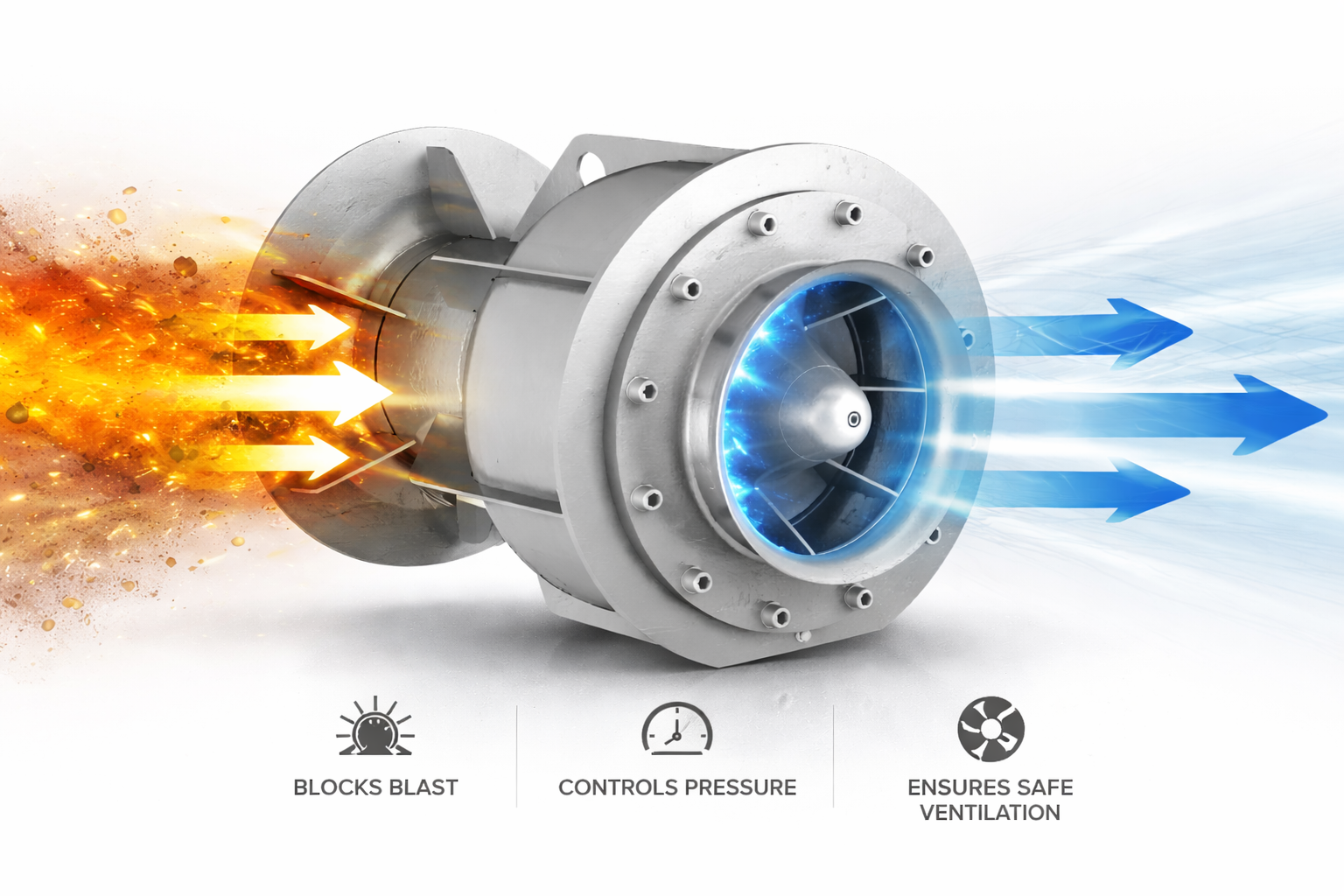
A blast valve’s purpose is simple and singular: stop a transient overpressure (shockwave) from entering a protected volume while allowing normal airflow the rest of the time. It closes automatically in milliseconds using mechanical inertia, springs, or counterweights and then reopens when pressure has equalised. That behaviour is very different from a valve used in a liquid system; the design priorities are shock resistance, sealing under impulse, and minimal leakage — not hydraulic flow control.
How it works under explosion pressure
Normal airflow: valve is open, free area provides low pressure drop.
Shockwave: rapid differential pressure forces the moving element to slam into its seat.
Hold: the structure and seat resist peak overpressure and impulse without deforming.
Reopen: return mechanism (spring, counterweight) restores flow after the event.
This sequence must be passive — life safety depends on it working even if electrical or pump systems fail.
Can a blast valve be connected to a water system?
Short answer: no, not directly. A blast valve is not designed for hydraulic service. Here’s why.
Mechanical design mismatch — moving parts and seals in blast valves are optimised for air velocities and shock loading, not for resisting continuous static water pressure, water hammer, or being submerged.
Sealing materials — gaskets and seat materials selected for air-tightness and high-speed impact may degrade under prolonged wetting, chemicals, or chlorinated water common in fire systems.
Corrosion and erosion — flowing water, especially with particulates or treatment chemicals, will erode seat surfaces and bearings that must remain precise to stop blast leakage.
Actuation and reset — hydraulic lines introduce risk of water ingress into mechanical linkages or pneumatic preloads, possibly jamming the valve in an open or closed position after an event.
Standards and certification — blast valves are tested to shock loading standards (peak overpressure and impulse). Fire and deluge valves follow hydraulic standards and approvals (IS/ISO/BS/UL/FM where applicable). Mixing systems undermines both certifications.
When combining systems can make sense (but with caution)
You can design a protected inlet that accommodates both blast protection and water washdown, but that requires separate, purpose-built components and careful engineering:
Separate paths — keep blast valve in the air stream and route water via dedicated spray nozzles or isolation valves outside the blast-critical moving parts.
Dual-function housings — only if a vendor supplies a tested assembly designed for combined loading; ask for third-party test evidence that the assembly performs under both blast and hydraulic conditions.
Drainage and isolation — ensure positive drainage so standing water cannot collect against the blast valve, and provide physical isolation between hydraulic lines and valve bearings.
Materials and coatings — water-facing parts need appropriate stainless grades or coatings (316L, duplex, or suitable epoxy lining) and seats compatible with both wet and dry cycles.
What this means for design and procurement
Pressure ratings and loading — specify peak overpressure and impulse for the blast valve, and separate static and dynamic pressures for any water system components.
Valve placement — in most bunker installations I prefer the blast valve upstream of any washdown nozzles and with an accessible inspection port.
Maintenance access — water exposure increases inspection frequency. Bearings, seats, and return springs must be serviceable without removing the whole housing.
Vendor claims — a manufacturer claiming a single device handles both blast and water without test reports is a red flag. Ask for shock tube or blast test data and hydraulic test certificates.
Standards to reference
Use relevant standards to separate responsibilities: NATO STANAG/EN test methods for blast; IS/ISO/BS/UL/FM for fire and hydraulic valves. A blast valve that lacks blast testing is useless regardless of low blast valve price.
Common mistakes I’ve seen on projects
Plumbing water to a blast valve housing to “save cost” — leads to seized mechanisms and failed protection.
Specifying without test evidence — buyers accept a lower blast valve price but get a valve that deforms or leaks under impulse.
Assuming a blast gate or blast damper works the same — dampers and gates aren’t built for shock loading and will fail.
Ignoring drainage — standing water corrodes return springs and seats, increasing failure risk.
How to evaluate suppliers in India
Ask for test reports first. Verify materials (316L or duplex where water is present), lifting weights, spring rates, and return cycle times. Check installation drawings for dedicated drainage and isolation. Confirm spare parts and maintenance training. A manufacturer who can’t produce third-party testing or references for combined environments is a non-starter.
Practical Example
At a power plant refurbishment I specified separate small-diameter deluge rings around an intake, with the blast valve upstream and physical separation of plumbing. That kept the blast valve dry and serviceable, allowed quick washdown, and preserved both protective functions without complex combined-device claims.
Summary
You can’t simply connect a blast valve to a water system. Blast valves are engineered for transient shock and airflow control; water systems require hydraulic design and corrosion resistance. If you need both functions, design separate but integrated systems or buy assemblies with independent testing that prove both behaviours. Treat blast valve selection as an engineering decision — match specifications, demand test data, and plan for maintenance. If you want, send me a vendor spec and layout; I’ll mark up where plumbing or design will compromise blast performance.

 English
 Arabic
 French
 Spanish
 Portuguese
 Deutsch
 Turkish
 Dutch
Dutch
 Italiano
 Russian
 Romaian
 Greek
Greek