

Courier Companies Don't Have a Delivery Problem. They Have a Technology Problem
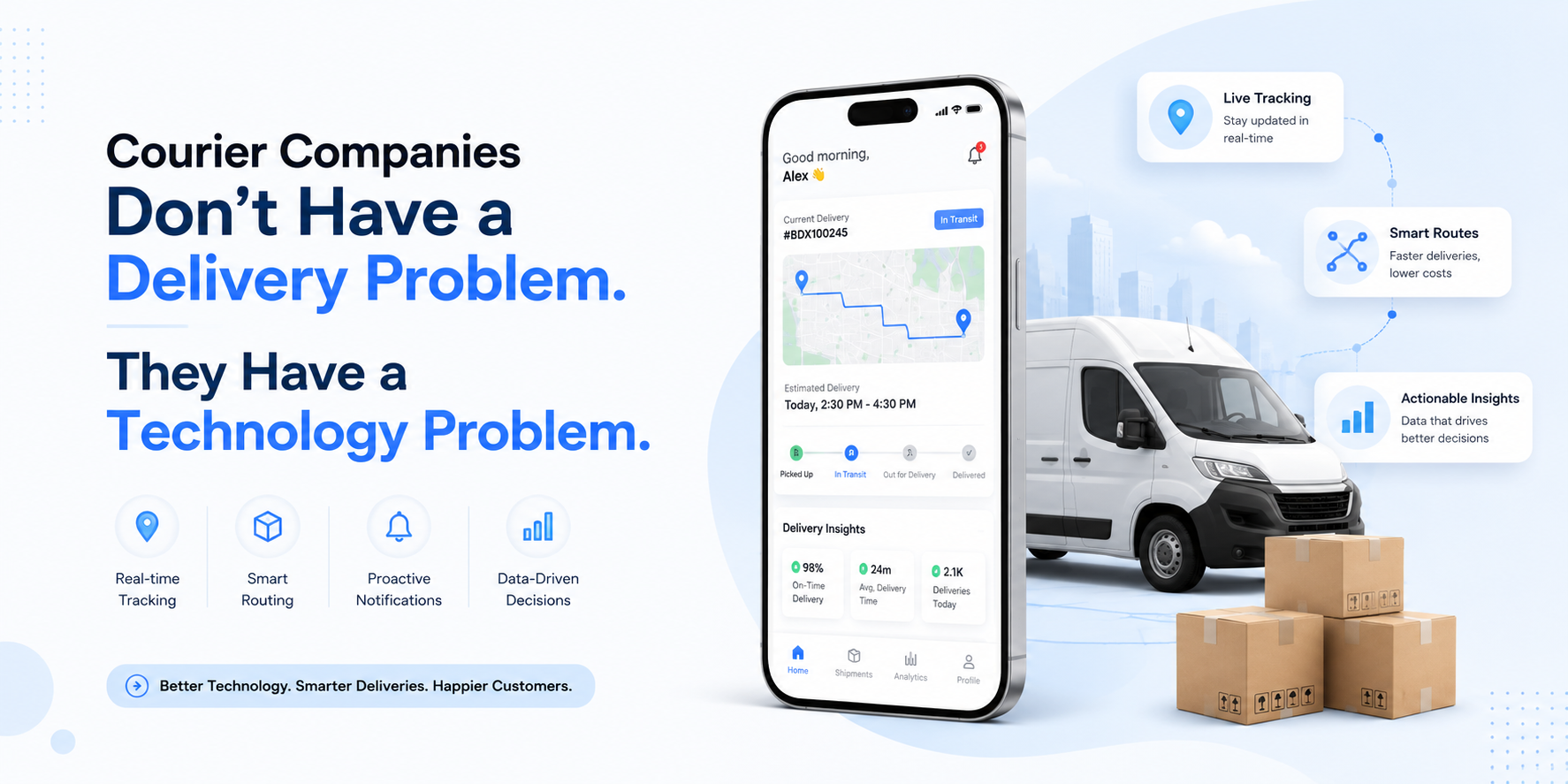
For years, courier and logistics businesses focused on expanding fleets, hiring more drivers, and increasing delivery capacity. Today, that strategy alone is no longer enough.
The biggest challenge facing courier businesses isn't moving packages from Point A to Point B.
It's managing the entire delivery ecosystem efficiently.
Customers want real-time tracking. Drivers need optimized routes. Dispatchers require operational visibility. Business owners need data-driven decisions.
Without the right technology, even the most experienced logistics companies struggle to scale.
The Hidden Cost of Manual Courier Operations
Many courier businesses don't realize how much revenue is lost through operational inefficiencies.
Common challenges include:
- Delayed order assignments
- Inefficient route planning
- Poor driver utilization
- Lack of real-time delivery visibility
- Customer support overload
- Missed delivery updates
- Limited business analytics
These issues create a ripple effect across the business:
- Higher operational costs
- Lower customer satisfaction
- Reduced delivery capacity
- Increased driver downtime
- Slower business growth
The result? Companies work harder but don't necessarily become more profitable.
Why Technology Has Become a Competitive Advantage
The courier industry is rapidly shifting from transportation-centric operations to technology-driven logistics.
Today's market leaders are winning because they can:
- Automate dispatching
- Track deliveries in real time
- Optimize routes dynamically
- Manage drivers efficiently
- Analyze operational performance
- Deliver a better customer experience
Technology is no longer a support function.
It's becoming the foundation of modern logistics businesses.
The Build vs. Scale Dilemma
When businesses recognize the need for digital transformation, they often face a difficult decision:
Should we build our own courier delivery platform?
While custom development sounds appealing, it often introduces challenges such as:
- Long development cycles
- High implementation costs
- Continuous maintenance requirements
- Feature development delays
- Scaling complexities
Many businesses spend months—or even years—developing technology before generating meaningful returns.
In fast-moving logistics markets, that delay can be costly.
Why White Label Courier Delivery Platforms Are Gaining Momentum
Forward-thinking logistics entrepreneurs are increasingly choosing white-label courier delivery app solutions.
The reason is simple:
Instead of investing resources into building software infrastructure, they can focus on growing the business.
A white-label platform provides:
- Faster deployment
- Lower technical risk
- Proven operational workflows
- Scalable architecture
- Brand ownership
- Continuous innovation
This approach allows businesses to launch quickly while maintaining complete control over their customer experience and brand identity.
The New Logistics Playbook
Successful courier companies are increasingly following a different growth model:
Step 1: Digitize operations
Step 2: Automate delivery workflows
Step 3: Improve customer visibility
Step 4: Optimize fleet performance
Step 5: Scale geographically
Technology becomes the engine that supports every stage of growth.
What Entrepreneurs Should Look For
A future-ready courier delivery platform should include:
- Customer application
- Driver application
- Admin dashboard
- Automated dispatch management
- Route optimization
- Fleet management
- Real-time tracking
- Analytics and reporting
- Multi-language support
- Business scalability
These capabilities help businesses transition from reactive operations to data-driven logistics management.
The Bottom Line
The next generation of courier leaders won't necessarily be the companies with the largest fleets.
They'll be the companies with the smartest delivery infrastructure.
Businesses that adopt scalable, technology-first logistics solutions can improve efficiency, enhance customer satisfaction, and accelerate growth without spending years building software from scratch.
Platforms from SpotnRides, such as Logistics Delivery Management Software, are helping courier businesses make that transition by providing a ready-to-launch, white-label delivery ecosystem that supports automation, visibility, and long-term scalability.
Because in today's logistics landscape, the real competitive advantage isn't just delivering packages faster.
It's building a delivery operation that can scale faster than the competition.

 English
 French
 Spanish
 Portuguese
 Deutsch
 Turkish
 Dutch
Dutch
 Italiano
 Russian
 Romaian
 Portuguese (Brazil)
 Greek
Greek