

NOC Code Finder: The Complete Guide to Finding, Understanding, and Using Your NOC Code for Canada Immigration in 2026
Every skilled worker who applies to immigrate to Canada through Express Entry, a Provincial Nominee Program, or a work permit faces the same foundational requirement: identifying the correct NOC code for their occupation. This single five-digit number shapes visa eligibility, determines which immigration programs are accessible, influences CRS scoring, and is one of the first elements an immigration officer evaluates on any application. Getting it right is not optional.
A NOC code finder is the tool that bridges the gap between a person's job title and the official classification their experience maps to under Canada's National Occupational Classification system. This guide covers the full structure of the NOC system, how TEER categories work, how to use a NOC code finder accurately, and what the consequences of choosing the wrong code are for your immigration application.
What Is the NOC System?
The National Occupational Classification (NOC) is Canada's official system for categorising every occupation in the Canadian labour market. It is jointly maintained by Employment and Social Development Canada (ESDC) and Statistics Canada, and it covers thousands of distinct occupations across all sectors of the economy.
The NOC assigns each occupation a unique code, provides a standardised title, describes the main duties associated with the role, lists typical employment requirements, and provides examples of specific job titles that fall within that group. This standardised framework serves multiple purposes across government, business, education, and immigration.
For immigration applicants, the NOC is the lens through which Immigration, Refugees and Citizenship Canada (IRCC) evaluates the type, level, and duration of work experience claimed in any application. The wrong code creates a mismatch between the work experience you describe and the duties listed in the classification, which can lead to refusal, return of application, or a finding of misrepresentation.
NOC 2021: The Current Version and Why It Replaced NOC 2016
Canada switched from NOC 2016 to NOC 2021 Version 1.0 on November 16, 2022. This was a fundamental structural overhaul, not just an update. Two major changes define what NOC 2021 looks like compared to its predecessor.
Change 1: Five-digit codes replaced four-digit codes Under NOC 2016, every occupation was identified by a four-digit number. Under NOC 2021, all codes became five digits. This expansion allowed for more granular classification of occupations and the introduction of new categories that did not exist in the previous system.
Change 2: TEER categories replaced Skill Types and Skill Levels The old system used Skill Type 0 (management) and Skill Levels A, B, C, and D. These have been completely replaced by six TEER categories numbered 0 through 5. TEER stands for Training, Education, Experience, and Responsibilities.
If you are reading older immigration guides that mention four-digit NOC codes, Skill Level A, or NOC B occupations, those references apply to the old system. IRCC now uses five-digit codes and TEER levels exclusively for all current applications.
Any NOC code finder you use should be based on the NOC 2021 system. Tools or databases referencing NOC 2016 codes will produce results that are no longer valid for Canadian immigration applications.
How to Read a Five-Digit NOC Code
Every five-digit NOC code encodes specific structural information that tells you exactly where an occupation sits in the classification hierarchy.
Digit 1: Broad Occupational Category The first digit places the occupation in one of ten broad categories:
| First Digit | Broad Occupational Category |
|---|---|
| 0 | Legislators and senior management |
| 1 | Business, finance, and administration |
| 2 | Natural and applied sciences |
| 3 | Health occupations |
| 4 | Education, law, social, community and government services |
| 5 | Arts, culture, recreation, and sport |
| 6 | Sales and service |
| 7 | Trades, transport, and equipment operators |
| 8 | Natural resources, agriculture, and related production |
| 9 | Manufacturing and utilities |
Digit 2: TEER Category The second digit is the TEER level of the occupation (0 through 5). This is the single most important digit for Express Entry eligibility purposes.
Digits 3 and 4: Minor Group The third and fourth digits together identify the minor group within that category, providing more specific classification.
Digit 5: Unit Group The fifth digit distinguishes the specific unit group within the minor group.
Practical example: NOC code 13102 is the code for Payroll Administrators.
- First digit 1: Business, finance, and administration category
- Second digit 3: TEER 3 occupation
- Digits 34: Minor group 34 within that category
- Digit 2: Unit group 2 within that minor group
This structure means that simply reading the second digit of any NOC code instantly tells you its TEER level and therefore its Express Entry eligibility status.
Read More : Canada Start-Up Visa
TEER Categories: The Most Important Factor for Immigration Eligibility
The TEER category is the element of the NOC code that most directly determines which immigration programs an applicant can access. Understanding TEER is essential before using any NOC code finder, because a tool that identifies your job title correctly but maps it to the wrong TEER level can lead to an application that fails eligibility checks.
TEER 0: Management Occupations
TEER 0 covers management and senior leadership roles. These occupations typically require significant management experience and accountability for organisational performance. They do not have a formal education prerequisite in the TEER definition, but in practice they require extensive prior experience in lower-tier positions.
Examples: Software engineering managers, health services managers, senior managers in construction and transportation
Express Entry eligibility: Fully eligible for all three Express Entry streams (FSWP, CEC, FSTP)
TEER 1: Professional Occupations Requiring University Degrees
TEER 1 covers occupations that typically require a bachelor's degree, master's degree, or doctorate at a recognised university. These are professional occupations across science, technology, engineering, health, law, and business.
Examples: Software developers (21232), civil engineers (21300), physicians (31102), lawyers (41101), accountants (11100)
Express Entry eligibility: Fully eligible for FSWP and CEC
TEER 2: Skilled Technical Occupations
TEER 2 covers occupations that typically require a two-year or longer college diploma, a completed apprenticeship program of two or more years, or supervisory responsibility in certain skilled trade occupations.
Examples: Registered practical nurses (32101), computer network technicians (22220), construction supervisors (72010), aircraft mechanics (72404)
Express Entry eligibility: Eligible for FSWP, CEC, and the Federal Skilled Trades Program (FSTP)
TEER 3: Technical and Skilled Occupations with Shorter Training
TEER 3 covers occupations that typically require a college diploma or an apprenticeship training period of less than two years, or more than six months of on-the-job training specific to that role.
Examples: Dental assistants (33100), transport truck drivers (73300), bricklayers (72320), payroll administrators (13102)
Express Entry eligibility: Eligible for FSWP and CEC. Some TEER 3 trade occupations are eligible for FSTP with a valid job offer or certificate of qualification.
TEER 4: Occupations Requiring Secondary School or Short Training
TEER 4 covers occupations that typically require completion of high school or several weeks of on-the-job training. These are generally considered lower-skilled occupations in the context of Canadian immigration programs.
Examples: Security guards (64100), food counter attendants (65201), home support workers (44101), cashiers (65100)
Express Entry eligibility: NOT eligible for Express Entry. Applicants whose occupation falls in TEER 4 must pursue alternative pathways to permanent residence.
TEER 5: Occupations Requiring Only Short Demonstration
TEER 5 covers occupations that require short-term work demonstration and no formal credential or training requirement.
Examples: Landscaping labourers (85100), light-duty cleaners (65310), fruit and vegetable pickers (85110)
Express Entry eligibility: NOT eligible for Express Entry.
The critical dividing line in Canadian immigration is TEER 3 versus TEER 4. Occupations in TEER 0, 1, 2, and 3 are considered skilled for immigration purposes and open access to Express Entry programs. Occupations in TEER 4 and 5 do not qualify for Express Entry, regardless of the applicant's CRS score, language ability, or education level.
What Is a NOC Code Finder and How Does It Work?
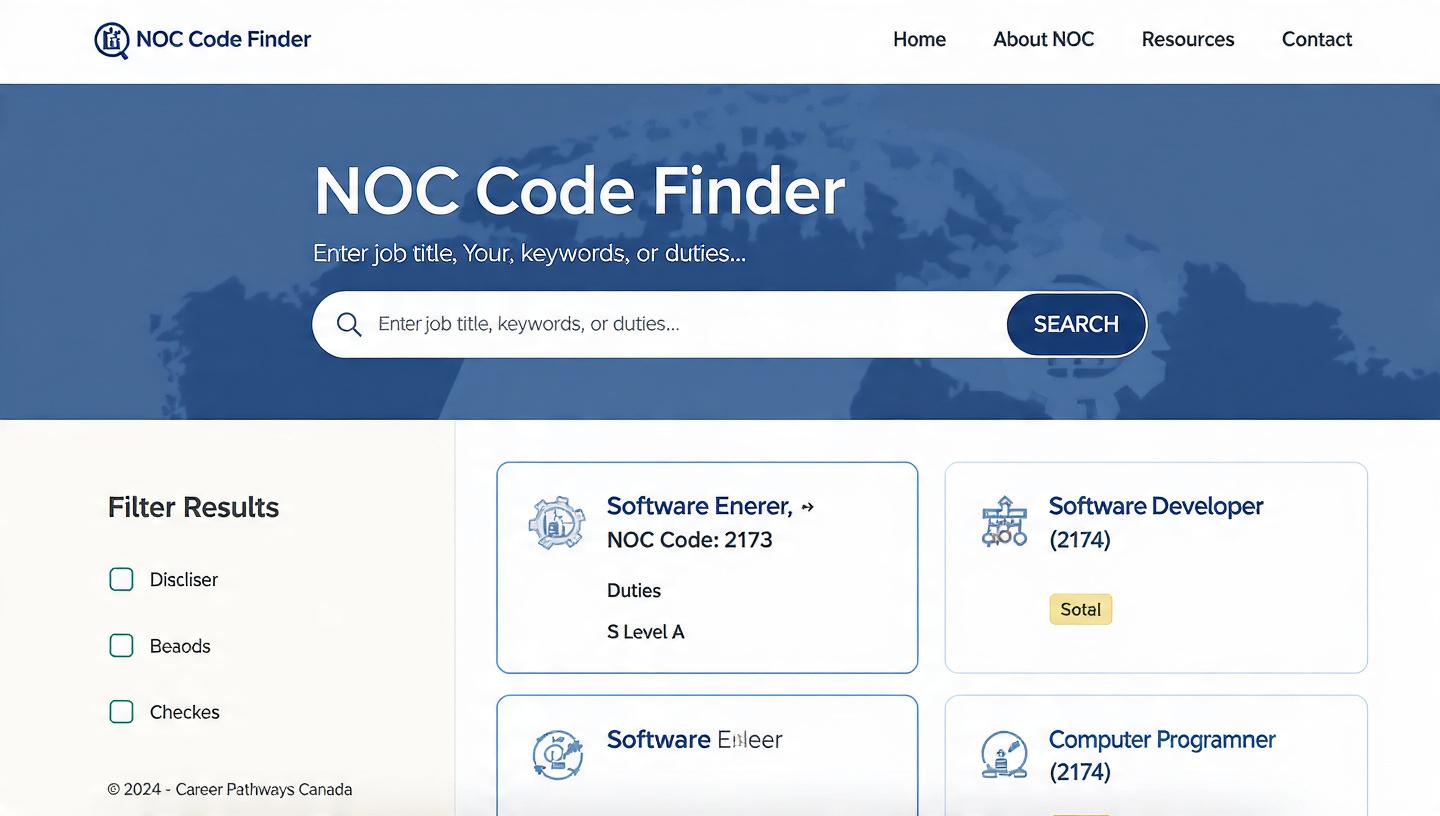
A NOC code finder is a search tool that takes a job title, occupation description, or keyword input and returns the NOC codes whose classification descriptions most closely match the duties and responsibilities of that role.
The best NOC code finder tools in 2026:
- Search by job title keyword or occupation description
- Return results from the NOC 2021 database with five-digit codes
- Display the TEER level clearly for each result
- Show the full unit group description including main duties, employment requirements, and example job titles
- Allow filtering by broad occupational category or TEER level
- Work on mobile devices for use during consultations or while completing online applications
Why job title alone is not always sufficient: Many applicants make the mistake of entering only their job title into a NOC code finder and accepting the first result without reviewing the duties description. Job titles across industries and countries vary enormously. A person whose official title is "Software Developer" at one company may perform duties identical to a "Systems Analyst" or "Application Programmer" in the NOC classification. The title is the starting point, not the final answer. The duties description is what matters.
Read More : Why More Americans Are Choosing
How to Use a NOC Code Finder Correctly: Step-by-Step
Step 1: Prepare a clear description of your actual duties
Before using any NOC code finder, write out the main duties you performed in the role for which you are claiming experience. Be specific. Note the technical tasks, the tools or systems you worked with, the decisions you made independently, the people or projects you supervised if applicable, and the qualifications required to perform the role.
Step 2: Enter your job title or key duties into the finder
Start with your official job title. If the search returns multiple results, compare each code's duty description against the duties you noted in Step 1. Look for the code whose main duties list most closely matches what you actually did at work.
Step 3: Read the full unit group description carefully
For any code that appears relevant, open the full description and read every element:
- The short overview statement describing the occupation
- The main duties list (this is the critical section)
- The employment requirements (education and training typically expected)
- Example job titles (to confirm the role falls within this group)
If the main duties listed match your actual work experience well, that code is likely correct. If you find yourself saying "I did most of these but not all" or "this is close but I mainly did something different," keep searching.
Step 4: Confirm the TEER level
Check the second digit of the code to identify the TEER level. Confirm that the TEER level is appropriate for the immigration program you are targeting. For Express Entry, you need TEER 0, 1, 2, or 3.
Step 5: Check the official IRCC and ESDC sources
Once you have a candidate code from a third-party NOC code finder, verify it against the official ESDC NOC website (noc.esdc.gc.ca) and the IRCC guidance page on finding your NOC. Official sources provide the authoritative version of each code's description and ensure you are working from the most current classification data.
Step 6: Seek professional review for ambiguous cases
If your role spans duties that appear in two different unit groups, if your job title is genuinely uncommon, or if you are uncertain whether your duties align better with TEER 2 or TEER 3, consult a Regulated Canadian Immigration Consultant (RCIC) or licensed immigration lawyer. The cost of a professional NOC assessment is far lower than the cost of a refused application or an application returned for incorrectly claimed work experience.
Common Mistakes People Make When Using a NOC Code Finder
Selecting a code based on title only, ignoring duties The most frequent and consequential error. Two codes may share a similar title while describing fundamentally different work. Always verify duties, not just title.
Using the old four-digit NOC 2016 codes If a tool returns four-digit codes, it is using the outdated system. Any immigration application submitted in 2024 or later must use five-digit NOC 2021 codes. Applications citing NOC 2016 codes will be incorrect.
Claiming the highest TEER level that seems remotely applicable Applicants sometimes select a TEER 1 code when their actual experience more accurately aligns with TEER 2 or TEER 3, hoping to strengthen their application. Immigration officers compare claimed work experience against the duties descriptions of the selected code. A mismatch between the code claimed and the evidence submitted can be treated as misrepresentation, which carries serious consequences including bans from future applications.
Confusing managerial and non-managerial codes A software engineer who sometimes leads a small team may be tempted to select a management code (TEER 0) rather than the engineering code (TEER 1). Unless the primary duties of the role were clearly managerial in nature, with responsibility for the overall direction of a function or team, the professional code is almost always more accurate.
Not updating the code after a job change Applicants who have worked in multiple roles may need to identify NOC codes for each period of experience they are claiming. Using the same code for different roles without checking whether each period of work actually aligns with that code's duties is an error that becomes visible during documentation review.
NOC Codes and Express Entry Immigration Programs
The NOC code links directly to eligibility for Canada's three Express Entry programs:
Federal Skilled Worker Program (FSWP) Requires at least one year of full-time skilled work experience in a TEER 0, 1, 2, or 3 occupation within the last 10 years, along with minimum language requirements and educational qualifications. The FSWP is the primary pathway for internationally trained workers who have not yet worked in Canada.
Canadian Experience Class (CEC) Requires at least one year of Canadian skilled work experience in a TEER 0, 1, 2, or 3 occupation within the last three years. This program is designed for temporary foreign workers and international graduates who have already built Canadian work history.
Federal Skilled Trades Program (FSTP) Requires work experience in specific TEER 2 or TEER 3 trade occupations. The eligible trade codes are listed explicitly by IRCC and include roles in industrial, electrical, construction, mechanical, and culinary trades. Unlike FSWP and CEC, FSTP also requires either a valid job offer for at least one year of employment or a certificate of qualification issued by a Canadian provincial or territorial authority.
For Provincial Nominee Programs (PNPs), NOC code eligibility varies significantly by province and stream. Some PNP streams target specific NOC codes aligned with provincial labour market needs. Others accept a wider range of TEER levels for specific occupations in demand. Each province maintains its own occupation list, and a NOC code that qualifies under one province's stream may not qualify under another.
NOC Codes and the 2026 Express Entry Category-Based Draws
Since 2023, IRCC has used category-based selection to issue invitations to specific groups of candidates rather than only drawing from the highest CRS scores across the full pool. In 2026, the active categories each target specific NOC codes.
Key examples from current 2026 categories:
Trades Occupations: Automotive service technicians (72410), aircraft mechanics (72404), electricians (72200), plumbers (72300), and related skilled trade codes are targeted in trades-specific draws.
Healthcare and Social Services: Registered nurses (31301), licensed practical nurses (32101), personal support workers (44101 is TEER 4 and not eligible for most streams), and allied health professionals in TEER 1 and 2 codes are targeted.
STEM Occupations: Software developers (21232), data scientists (21211), electrical engineers (21310), and other TEER 1 and 2 codes in natural and applied sciences are targeted.
French-Language Proficiency: This category is not NOC-code specific. It targets candidates with French language proficiency at NCLC 7 or higher regardless of their occupation.
Senior Management: Senior managers in health, education, community services (00013), trade and broadcasting (00014), and construction and transportation (00015) are targeted in management draws.
A NOC code finder that flags whether your occupation is included in any current category-based draw helps you understand not just your basic eligibility but your competitive position in the specific draws most relevant to your profile.
Final Thoughts
The NOC code finder is the starting point of every successful Canadian immigration application for skilled workers. It translates years of professional experience into the standardised language that immigration officers, provincial nominee programs, and Express Entry systems use to evaluate every application.
Finding the right code requires more than typing a job title into a search bar. It requires reading and matching duties descriptions, understanding the TEER level system, verifying results against official sources, and confirming that the code you select accurately reflects the work you performed and can be supported with the documentation in your application package.
Take the time to do this step correctly. The NOC code you select shapes every downstream decision in your immigration journey, from program eligibility to CRS scoring to PNP stream targeting. A correctly identified NOC code, well supported by employment records and reference letters that describe the same duties, is the foundation on which a strong Canadian immigration application is built.
 Dutch
Dutch
 English
 Arabic
 French
 Spanish
 Portuguese
 Deutsch
 Turkish
 Italiano
 Russian
 Romaian
 Portuguese (Brazil)
 Greek
Greek