

Hidden Blast Damper Failures Nobody Warns You About
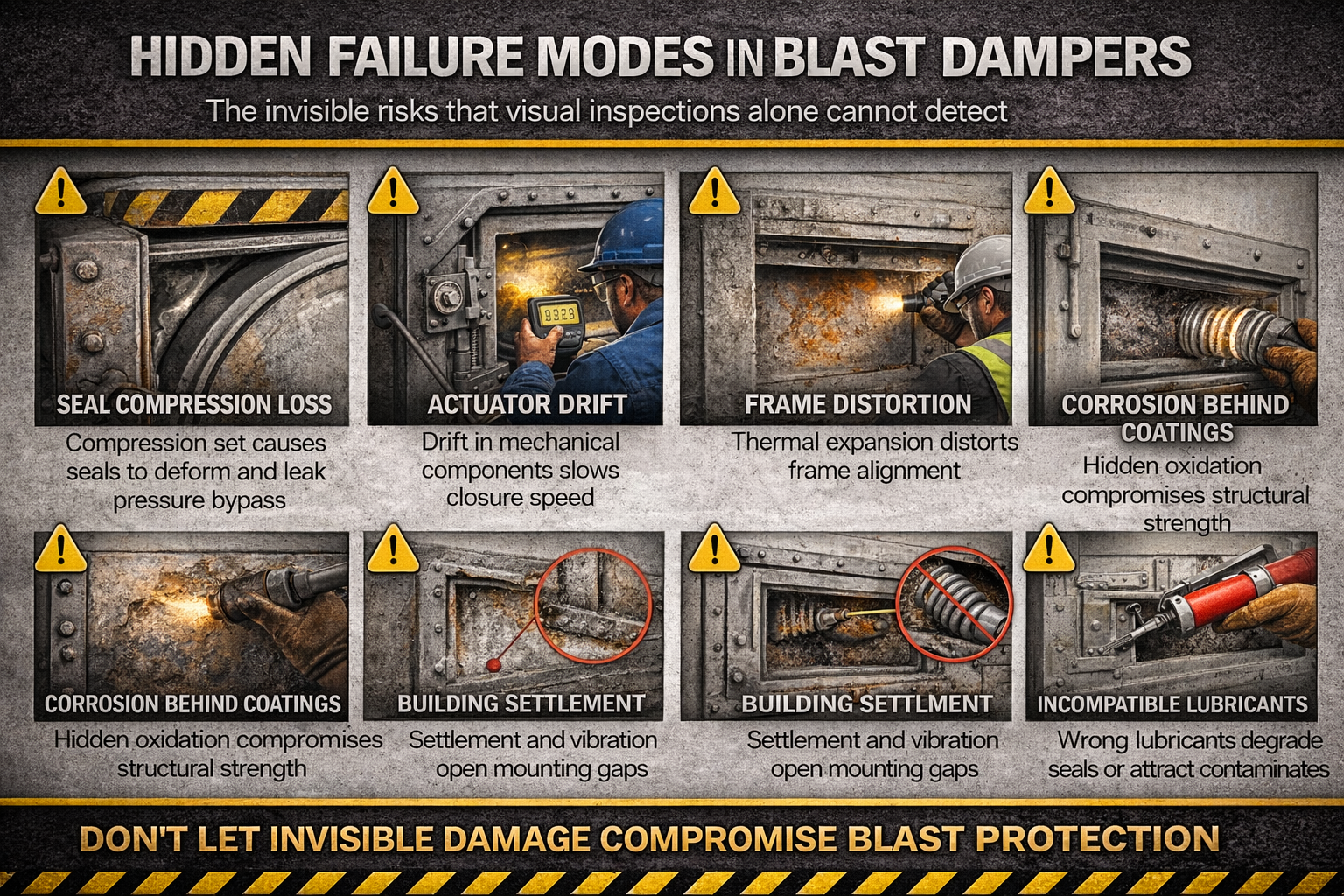
Most industrial facilities conduct regular safety inspections. Checklists are completed, sign-offs are filed, and equipment is visually confirmed to be in place. Yet blast damper failures continue to occur — not because facilities are careless, but because the most dangerous failure modes are the ones that look perfectly fine during a routine check.
A blast valve can appear fully operational during a visual inspection and still fail to close at the required speed during an actual overpressure event. A blast damper can pass a basic condition check and still leak pressure at its mounting interface. These are not edge cases. They are the failures that industrial safety systems are most vulnerable to precisely because they are hardest to see.
Here are seven hidden failure modes that rarely appear in standard guidance — but that every facility managing explosion protection risks needs to understand.
Seal Compression Loss That Is Invisible to the Eye
Seals in blast dampers degrade gradually over time through compression set — a process where repeated minor pressure fluctuations and temperature cycling cause the seal material to permanently deform. The seal remains physically present and looks intact during inspection, but it no longer achieves the compression necessary to prevent pressure bypass when the damper closes.
In an explosion event, this invisible degradation translates to a closed damper that still leaks overpressure into the protected zone. The only way to detect compression set is through measured seal performance testing — not visual inspection.
Actuator Drift That Slows Closure Below Safe Thresholds
Blast valve actuators — whether mechanical, pneumatic, or electrical — are calibrated to deliver closure within a specified time window. Over months and years of exposure to vibration, temperature variation, and minor contamination, actuator response can drift outside that window without triggering any visible alarm.
A damper that closes in 80 milliseconds instead of its rated 25 milliseconds may appear to be functioning normally in every observable respect. In a real blast event, that drift means the pressure wave arrives before the valve has closed. Functional closure speed testing at regular intervals is the only reliable detection method.
Evaluate your current safety systems by scheduling actuator response time testing across all blast-rated dampers in your facility.
Frame Distortion from Thermal Cycling
Industrial environments subject ductwork and damper housings to repeated thermal expansion and contraction. Over time, this cycling can cause subtle distortion of the damper frame — enough to misalign the blade or gate mechanism so that it no longer achieves a full, uniform seal across its entire surface when closed.
This distortion is rarely visible without measurement. The damper closes, appears closed, and would be recorded as compliant during a standard inspection. Under overpressure, the misaligned blade creates a pressure bypass pathway that compromises the entire barrier.
Corrosion Behind Protective Coatings
Many blast dampers are supplied with corrosion-resistant coatings appropriate for their rated environment. What facilities often fail to account for is that coating integrity degrades over time — particularly at edges, fastener points, and areas subject to abrasion from airflow particulates.
Once the coating is compromised, substrate corrosion develops underneath — invisible from the surface. By the time corrosion is visible, structural integrity may already be significantly reduced. In HVAC safety applications where dampers are exposed to humid, chemically active, or salt-laden air, coating inspection and renewal schedules are as important as mechanical performance testing.
Mounting Interface Gaps Created by Building Settlement
A blast damper installed with perfect gap tolerances at commissioning may develop bypass pathways years later as the surrounding structure settles. Building settlement, particularly in facilities constructed on variable soil conditions or subject to heavy operational vibration, can open gaps between the damper frame and the blast wall penetration that were not present at installation.
These gaps are often obscured by surface finishes, insulation, or adjacent pipework. Pressure that cannot pass through a correctly closed damper will find and exploit these bypass routes instead. Periodic inspection of mounting interfaces — not just the damper itself — is an essential but frequently omitted maintenance step.
Spring Fatigue in Passive Mechanical Units
Passive blast dampers rely on calibrated springs to drive rapid closure when overpressure is detected. These springs are specified to deliver a precise closing force within a precise time window. Like all mechanical springs under repeated stress, they are subject to fatigue — a gradual reduction in elastic force that happens below the threshold of any visual detection method.
A spring that has lost fifteen percent of its rated force may still close the damper under normal test conditions but fail to close it quickly enough under actual blast overpressure, where the forces opposing closure are far greater. Spring condition can only be reliably assessed through load testing — a step that most standard maintenance protocols do not include.
Consider incorporating spring load testing into your blast damper maintenance programme to detect fatigue before it becomes a critical failure.
Incompatible Lubricants Applied During General Maintenance
General maintenance teams servicing HVAC systems sometimes apply standard lubricants to blast damper mechanisms during routine servicing — not out of negligence, but because the damper is in the ductwork alongside standard components and the distinction is not always clearly communicated.
Certain lubricants are chemically incompatible with the seal materials used in blast-rated components, causing accelerated degradation that is not immediately visible. Others attract particulate contamination that increases mechanical resistance, slowing closure times incrementally with each service cycle. Facilities that specify industrial blast valve solutions from reputable manufacturers should ensure that approved maintenance materials are documented and communicated explicitly to every team that accesses the system.
Conclusion
The most dangerous blast damper failures share a common characteristic — they are invisible during the inspections that are supposed to catch them. Seal compression loss, actuator drift, frame distortion, hidden corrosion, mounting gaps, spring fatigue, and lubricant incompatibility each degrade explosion protection performance silently, leaving facilities operating under the assumption of safety they no longer have.
 Dutch
Dutch
 English
 Arabic
 French
 Spanish
 Portuguese
 Deutsch
 Turkish
 Italiano
 Russian
 Romaian
 Portuguese (Brazil)
 Greek
Greek