Modern businesses rely heavily on ERP systems—they connect departments, streamline workflows, and keep operations moving (at least in theory). Yet, when these systems slow down, productivity quietly suffers and frustration builds faster than expected. Many organizations discover this the hard way—usually during peak operations, when every second matters. Speed and scalability are no longer optional features; they are fundamental expectations. The real question is not whether optimization is needed—but how to achieve it without disrupting ongoing processes. So—let’s explore practical ways to make ERP systems faster and more scalable.
Understanding ERP Performance Bottlenecks
Every slow ERP system has a story behind it (and rarely a simple one). Performance issues often stem from overloaded databases, inefficient queries, or outdated system architecture that struggles to keep up with growing demands. Sometimes, the root cause hides beneath layers of seemingly functional code—only revealing itself under pressure. Identifying these bottlenecks early is crucial; otherwise, optimization becomes guesswork. Careful analysis, monitoring, and diagnostics help uncover the real issues. Once the bottlenecks are clearly understood (finally), optimization efforts can be targeted and effective.
Database Optimization Strategies
Databases often take the blame for sluggish ERP performance—and sometimes, rightfully so. Poor indexing, unoptimized queries, and excessive data retrieval can significantly slow down operations. Strategic indexing and query refinement help reduce response times, while caching frequently accessed data minimizes repeated processing. Balancing normalization and denormalization also plays a key role in maintaining efficiency. Interestingly, databases are not always the culprit—but they are always part of the solution. With proper tuning, they can transform from bottlenecks into performance boosters (which is where they belong).
Efficient Backend Architecture
Behind every high-performing ERP system lies a well-structured backend architecture (even if users never see it). Monolithic systems may struggle as workloads increase, whereas microservices-based designs offer flexibility and scalability. Load balancing ensures that no single server becomes overwhelmed, while optimized APIs improve communication between components. Thoughtful ERP software development decisions at this stage can prevent major performance issues later. Architecture may seem like a background detail—but in reality, it defines how efficiently the system scales under pressure.
Frontend Performance Optimization
Users often judge ERP performance by how quickly screens load and actions respond (fair or not, that’s reality). A sluggish interface can overshadow even the most efficient backend systems. Techniques like lazy loading, minimizing API calls, and optimizing UI components can dramatically improve responsiveness. Clean design and efficient rendering ensure smoother user experiences. Because in practice, speed is not just about processing data—it’s about how quickly users perceive results. Even small improvements on the frontend can create a noticeably faster system.
Scalability Planning from Day One
Scalability is not something to bolt on later—it must be part of the initial design. As businesses grow, ERP systems must handle increasing users, transactions, and data volumes without slowing down. Horizontal scaling allows systems to expand across multiple servers, while vertical scaling enhances existing resources. Cloud-based solutions make this process more flexible and efficient. Experienced ERP developers understand that planning for growth early avoids costly redesigns later. Scalability, when done right, feels invisible—but its absence becomes obvious very quickly.
Role of Cloud and Infrastructure Optimization
Infrastructure decisions quietly influence ERP performance more than most realize. Cloud platforms offer flexibility, reliability, and scalability that traditional setups often lack. Features like auto-scaling, containerization, and distributed computing help systems adapt to varying workloads. Tools such as Docker and Kubernetes simplify deployment and management. However, performance is not just about using the cloud—it’s about using it wisely. A well-optimized infrastructure ensures consistent speed while keeping operational costs under control (which is always a balancing act).
Code Optimization and Best Practices
Code quality directly impacts how efficiently an ERP system performs (and how well it ages over time). Redundant processes, inefficient loops, and outdated logic can gradually slow down operations. Regular refactoring, adherence to coding standards, and performance profiling help maintain clean and efficient codebases. It is often surprising how small improvements can lead to noticeable gains. Code that once worked perfectly may become inefficient as systems evolve—so continuous refinement is essential. Good code supports scalability; poor code quietly resists it.
Real-Time Data Processing and Caching
Modern ERP systems increasingly rely on real-time data to support decision-making. However, processing data in real time can strain system resources if not managed carefully. Caching solutions like Redis or Memcached help reduce repeated computations and speed up responses. The challenge lies in balancing speed with data accuracy—especially when dealing with frequently changing information. Smart caching strategies ensure that users get timely data without overwhelming the system. Because in business operations, delayed insights can be almost as problematic as incorrect ones.
Security vs. Performance Balance
Performance improvements should never come at the cost of security (even if shortcuts seem tempting). Encryption, authentication, and access control mechanisms are essential—but they can also introduce overhead if poorly implemented. The key lies in designing security layers that are both robust and efficient. Over-engineering security can slow systems unnecessarily, while under-protecting creates risks. Finding the right balance ensures that ERP systems remain fast and secure. After all, a fast system that compromises data integrity is not truly optimized.
Monitoring, Testing, and Continuous Improvement
Optimization is not a one-time task—it is an ongoing process. Continuous monitoring helps detect performance issues before they impact users. Tools like New Relic and Datadog provide insights into system behavior, while load testing ensures readiness for peak conditions. Regular performance reviews and updates keep systems aligned with evolving demands. Small adjustments over time often prevent major disruptions later. Consistency in monitoring and improvement transforms optimization from a reactive effort into a proactive strategy.
Personal Anecdote / Observation
A particularly challenging ERP project once revealed how minor inefficiencies can escalate under pressure. Everything seemed functional during testing—until real users and data volumes exposed hidden bottlenecks. Response times increased, frustration followed, and quick fixes proved ineffective. A deeper analysis uncovered inefficient queries and unnecessary API calls working together to slow the system. After careful optimization, performance improved dramatically. That experience reinforced a simple lesson—issues rarely appear in isolation, and real-world usage often tells a different story than initial testing.
Best Practices Checklist
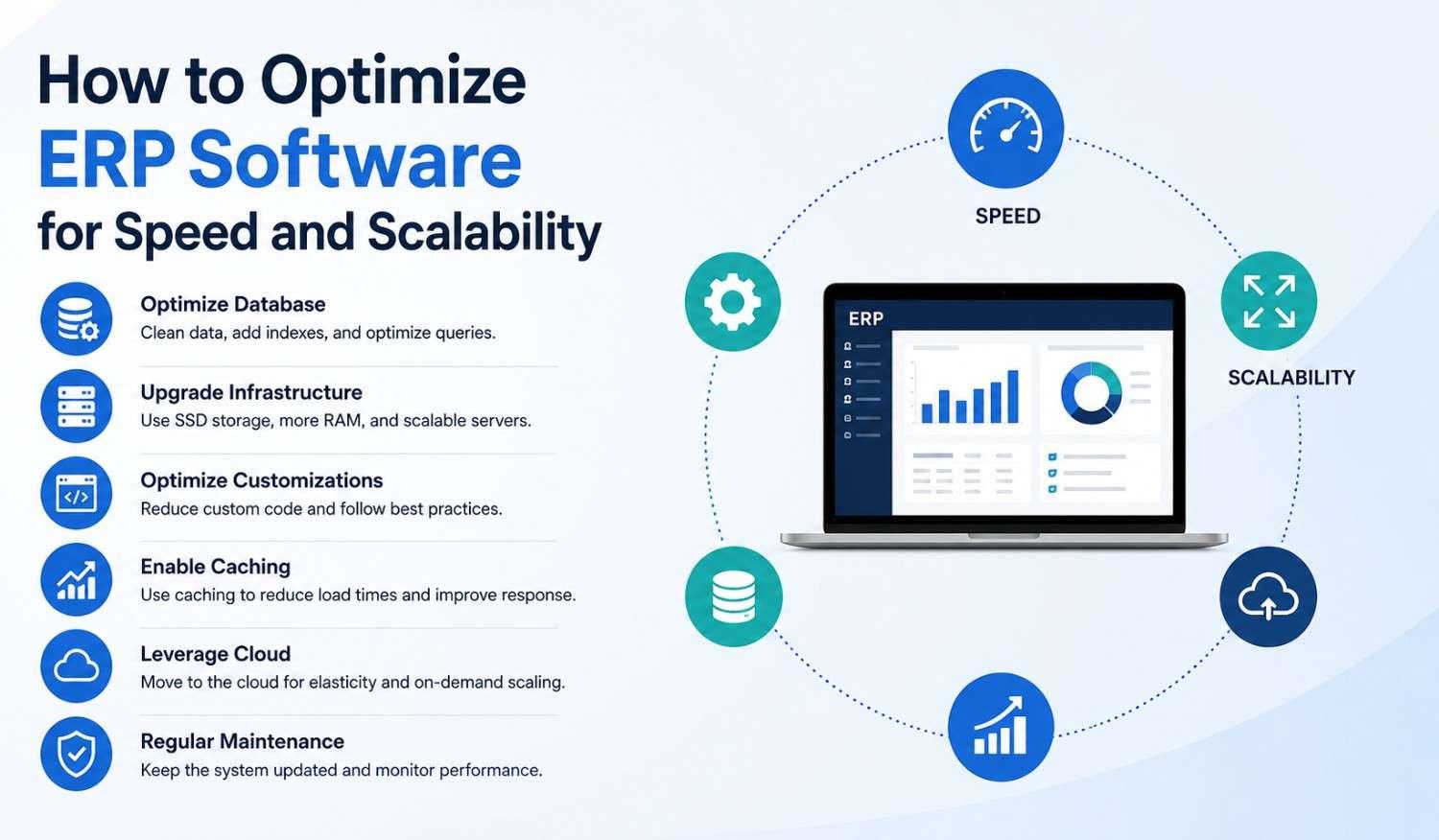
Optimizing ERP systems involves multiple moving parts—but a few consistent practices make a significant difference. Efficient database queries, strategic caching, and scalable architecture form the foundation. Regular monitoring and performance testing ensure that issues are detected early. Clean, maintainable code supports long-term efficiency. While these steps may seem straightforward, implementing them effectively requires discipline and attention to detail. In practice, consistency matters more than complexity when it comes to achieving reliable performance improvements.
Conclusion
Optimizing ERP systems for speed and scalability is less about quick fixes and more about thoughtful, continuous improvement. Each layer—from database to infrastructure—plays a role in overall performance. Small inefficiencies, if ignored, can grow into significant challenges over time. With the right strategies, however, ERP systems can remain fast, reliable, and adaptable. Because ultimately, an optimized system does more than improve efficiency—it supports growth, enhances user experience, and keeps businesses moving forward without unnecessary friction.
FAQs
Q1: Why do ERP systems become slow over time?
ERP systems often slow down due to increasing data volumes, outdated architecture, and inefficient code that accumulates over time. Lack of regular maintenance and optimization also contributes to performance degradation.
Q2: How can scalability be improved in ERP systems?
Scalability can be enhanced through cloud infrastructure, load balancing, and adopting microservices architecture. These approaches allow systems to handle increased demand without compromising performance.
Q3: What tools help monitor ERP performance?
Performance monitoring tools like New Relic, Datadog, and application profiling tools help track system health, identify bottlenecks, and optimize resource usage effectively.
Q4: Is caching necessary for ERP optimization?
Caching significantly improves performance by reducing repetitive data processing. It ensures faster response times, especially for frequently accessed data.
Q5: How often should ERP systems be optimized?
Optimization should be an ongoing process rather than a one-time effort. Regular monitoring, testing, and updates help maintain consistent performance as business needs evolve.


 English
 Arabic
 French
 Spanish
 Portuguese
 Deutsch
 Turkish
 Dutch
Dutch
 Italiano
 Russian
 Romaian
 Portuguese (Brazil)
 Greek
Greek